The Next Wave of Artificial Intelligence
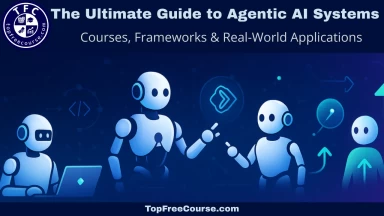
Artificial Intelligence has come a long way — from simple pattern recognition to advanced large-language models (LLMs) that can reason, create, and learn. But the newest phase of AI development goes beyond automation. It’s called Agentic AI, and it’s transforming how we interact with technology.
Imagine AI systems that don’t just follow instructions but think, plan, and act on their own. These “agents” can complete tasks, analyze data, generate ideas, and even build other AI tools — all with minimal human input. Companies are already using Agentic AI for research, code generation, marketing, and operations. As demand grows, employers are seeking professionals who understand how agent-based systems work.
If you’re preparing for AI interviews or looking to upskill, this guide will walk you through key interview questions, simple explanations, and free resources to master Agentic AI.
What Is Agentic AI?
Agentic AI refers to artificial intelligence systems capable of autonomous decision-making. Unlike traditional models that respond to prompts, Agentic AI operates through a feedback loop — setting goals, analyzing outcomes, and continuously improving performance.
Think of it as an AI that not only answers your question but also figures out why you’re asking and what needs to happen next.
In simpler terms:
Traditional AI = reactive.
Agentic AI = proactive.
Why Agentic AI Matters in 2025
Autonomy and adaptability: Agents can learn from their environment and adjust strategies.
Productivity multiplier: They handle repetitive, multi-step tasks, freeing humans for creative work.
Scalable intelligence: From startups to global firms, agentic systems can operate 24/7 without supervision.
Career opportunity: As Agentic AI frameworks gain traction, roles like AI Engineer, Prompt Architect, and Agent Developer are emerging worldwide.
Common Agentic AI Interview Questions and Answers
1. What makes Agentic AI different from traditional AI?
Traditional AI models process data and deliver outputs based on training. Agentic AI, however, incorporates goal orientation — it plans, executes, and evaluates its actions. It can chain multiple reasoning steps together, similar to how humans solve problems.
2. What is an AI-agent loop?
An AI-agent loop involves four stages:
Goal setting: defining the objective.
Action planning: deciding how to reach it.
Execution: performing the task.
Reflection: analyzing results and improving.
This loop enables self-correction and continual learning.
3. Which frameworks are popular for building AI agents?
LangChain: Connects LLMs with external data and APIs.
AutoGPT: Allows GPT-based agents to plan and complete complex goals.
CrewAI: Focuses on multi-agent collaboration.
MetaGPT: Builds “startup-like” agent teams that simulate roles.
BabyAGI: Lightweight experimental project for task-based automation.
4. What are the key challenges in Agentic AI?
Ensuring reliability: agents can drift or hallucinate.
Managing ethical risks: autonomous decisions raise accountability questions.
Maintaining transparency: complex reasoning makes explainability difficult.
Handling resource usage: multi-step reasoning can be computationally heavy.
5. What are some real-world applications?
Customer-support agents that resolve issues without escalation.
Research assistants that summarize papers and generate insights.
Marketing bots that write, design, and schedule campaigns.
Software agents that debug or refactor code automatically.
Bonus Technical Questions for Advanced Interviews
Q: How do Agentic AI systems integrate with external APIs?
A: Through “tool calling” — an agent invokes functions or APIs based on task context, extending its capabilities beyond text generation.
Q: What is reflection in Agentic AI?
A: Reflection allows agents to evaluate their intermediate outputs, identify mistakes, and re-attempt tasks, similar to human critical thinking.
Q: How do you evaluate the performance of an AI agent?
A: By measuring goal-completion rate, reasoning efficiency, error recovery, and response quality across varied tasks.
Learn Agentic AI for Free
The best part? You don’t need a paid bootcamp. Here are some completely free resources to master Agentic AI from the ground up.
Course | Focus | |
Coursera | AI for Everyone by Andrew Ng | Understand AI principles and applications |
DeepLearning.AI | LangChain for LLM Application Development | Build agents and reasoning workflows |
YouTube | AutoGPT Tutorials & CrewAI Setup Guides | Hands-on coding experience |
Free AI & LLM Learning Tracks | Curated Agentic AI and automation courses |
How to Prepare for an Agentic AI Interview
Learn the fundamentals: Study LLMs, vector databases, prompt engineering, and reasoning frameworks.
Build a project: Create a simple AutoGPT or LangChain agent that performs a real-world task.
Understand system design: Be able to explain how data flows through APIs, memory stores, and reasoning loops.
Follow updates: Agentic AI is evolving weekly; stay tuned to open-source communities.
Show curiosity: Employers value candidates who experiment, innovate, and demonstrate genuine interest.
The Future of Agentic AI Careers
By 2026, agentic systems will power everything from finance automation to personalized education. Professionals who learn how to design, control, and improve these agents will be among the most valuable in the tech ecosystem.
Even if you’re just starting your journey, the opportunity is massive. With open-source tools, community support, and free online courses, you can position yourself at the forefront of the AI revolution — without spending a single dollar.
Final Thoughts
Agentic AI represents the shift from AI as a tool to AI as a teammate. It’s no longer about asking the machine what to do — it’s about collaborating with intelligent systems that can think and act.
Start by learning the basics, exploring free tools, and experimenting with real-world projects. The next big interview question might not be “Can you code?” but “Can you build an AI that codes for you?”
Begin your journey today at TopFreeCourse.com — explore free, hand-picked courses on AI, automation, and future technologies to become part of the Agentic AI generation.